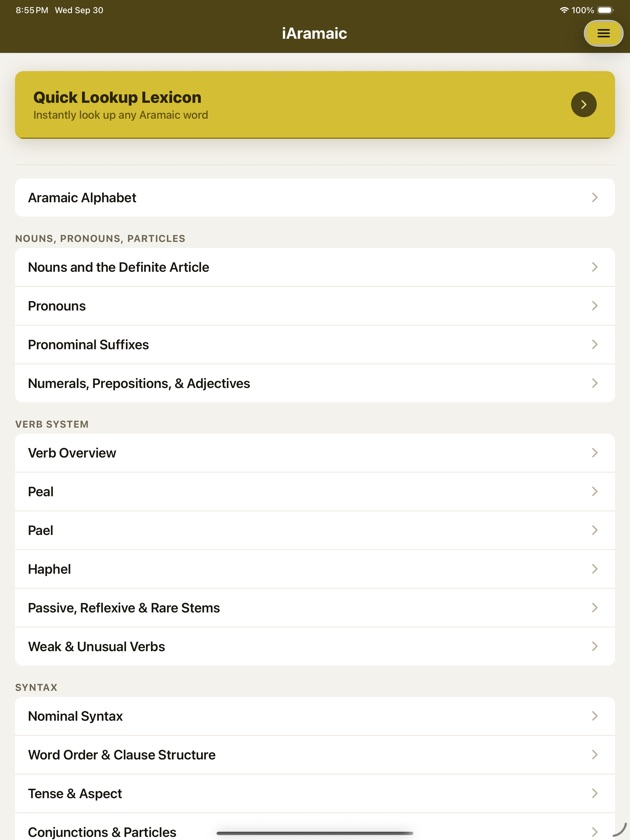
iAramaic is for readers of Daniel and Ezra who already have some Hebrew or Aramaic behind them and want a fast way to check a form. It puts the grammar of Biblical Aramaic in your pocket, laid out the way you’ll meet it in class. Short, clear pages cover the alphabet, nouns and the determined state, pronouns and suffixes, and each verb stem from Peal to Hitpaal. When you want to check a form, a full paradigm chart is a tap away. The grammar summary follows Greenspahn’s An Introduction to Aramaic.
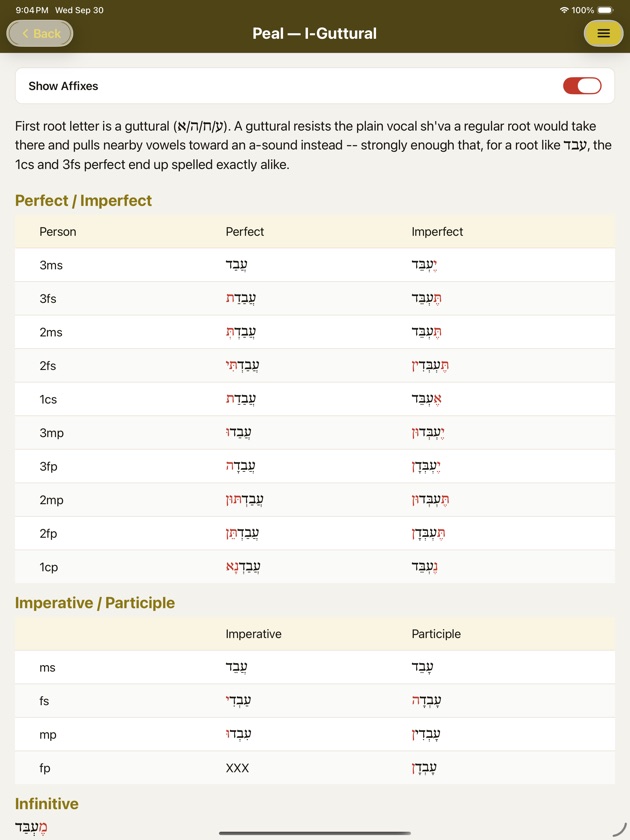
The paradigms cover every stem and the common weak roots: I-guttural, I-nun, I-yod/vav, III-aleph/he, hollow and geminate. Turn on Show Affixes and the prefixes and suffixes turn red, so you can see at a glance what marks a Haphel imperfect or a determined plural like מַלְכַיָּא. The switch stays where you left it from page to page.
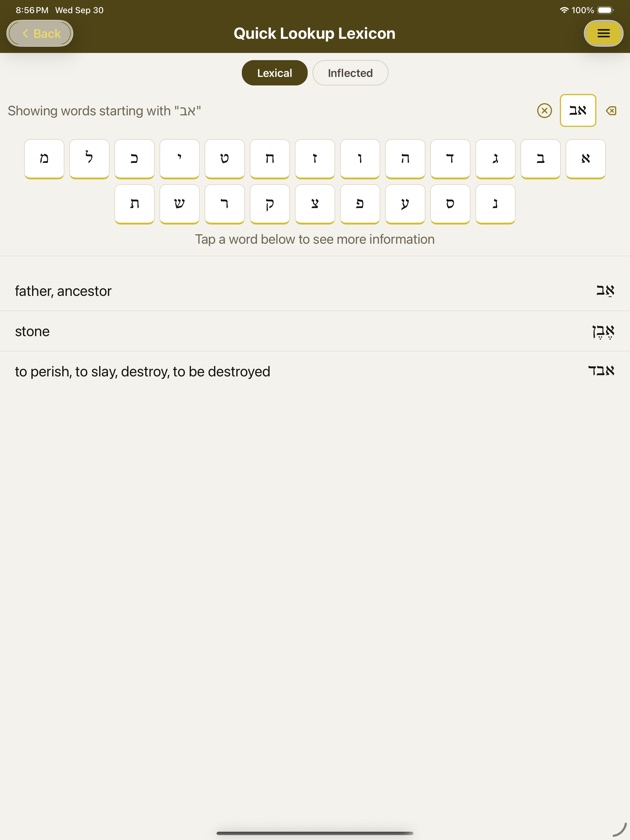
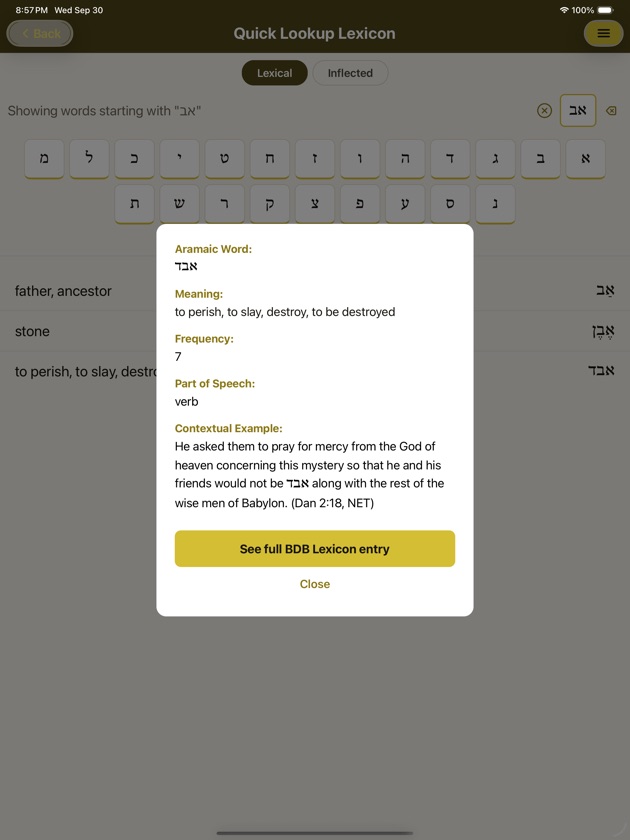
When a word in Daniel or Ezra stops you, the quick lookup lexicon finds it from its consonants, whether you type the dictionary form or the form as it’s printed. Each entry gives the meaning, frequency, part of speech and an example verse, with the full BDB article one more tap away. Everything is on your device, so it works without a connection.
What you can do
- Read concise grammar pages on the alphabet, nouns and the determined state, pronouns, pronominal suffixes, numerals, prepositions and adjectives.
- Work through the verb system: an overview, then Peal, Pael, Haphel, the passive, reflexive and rare stems, and weak and unusual verbs.
- Check full paradigm charts (perfect, imperfect, imperative, participle, infinitive, jussive) for every stem and the common weak roots.
- Compare all eight stems side by side on the Summary Verb Chart.
- Turn on Show Affixes to highlight prefixes and suffixes in red on grammar and paradigm pages.
- Look up any word in the quick lookup lexicon by its dictionary form or by the form as it's printed in Daniel and Ezra.
- See each word's meaning, frequency, part of speech and an example verse, then open the full BDB entry.
- Browse the full 704-word glossary letter by letter.
- Read syntax pages on nominal clauses, word order, tense and aspect, conjunctions and particles, and idioms.
- Use it fully offline, with no account and no ads.