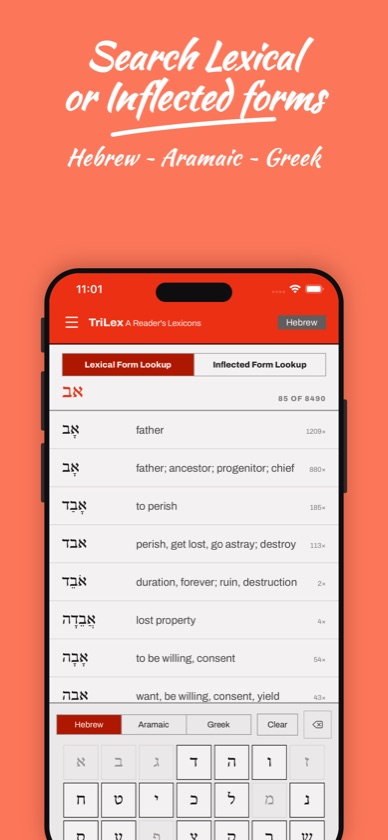
TriLex is for advanced students working toward reading the Hebrew Bible and the Greek New Testament with nothing but a lexicon at hand. It answers one question as fast as possible: what does this word mean? Pick Hebrew, Aramaic or Greek, tap the letters on the app’s own keyboard, and the list narrows with every letter. Tap a word for its gloss, frequency, part of speech and a verse that uses it, then open the full BDB or LSJ entry when you need more.
When you meet a form you can’t place, switch to inflected form lookup and type the word as it’s printed in your text. TriLex shows the lemma it comes from and how the form is parsed, so ἐδίδασκεν leads you straight to διδάσκω. If a form could belong to more than one word, TriLex lists each possibility rather than guessing.
Everything lives on your phone. There’s no account, no ads and no connection needed once it’s installed, so it works in a seminar room, a library basement or on a plane.
What you can do
- Look up Biblical Hebrew, Biblical Aramaic and New Testament Greek words in one app, switching languages with a tap.
- Find a word by its dictionary form, with the list narrowing as you type each letter.
- Type a form exactly as it's printed in your text and see its lemma and parsing.
- See a word's gloss, frequency, part of speech and an example verse on one card.
- Read the complete BDB entry for Hebrew and Aramaic words, or the complete LSJ entry for Greek, with pinch-to-zoom.
- Browse each full lexicon letter by letter, like the page headers of a printed dictionary.
- Type on built-in Hebrew-script and Greek keyboards. Letters that can't continue your search are dimmed.
- Use it fully offline, with no account and no ads.