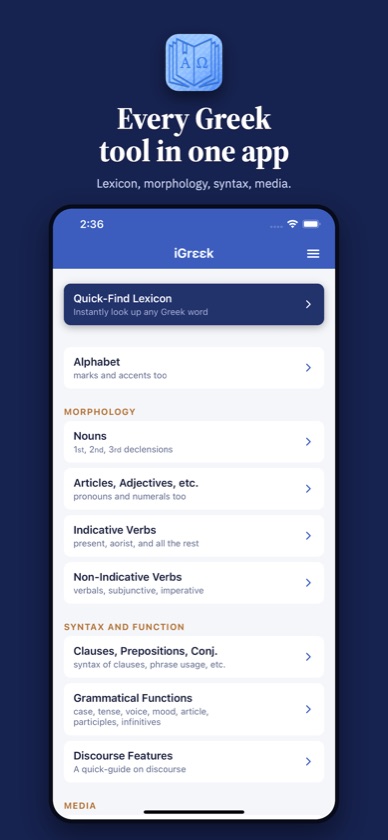
iGreek is for the years after your Greek courses, when you’re reading the New Testament and a form or a word stops you. If you’ve had a year or two of Greek, it gives you the paradigm, the parsing or the gloss in seconds, so you can get back to the text.
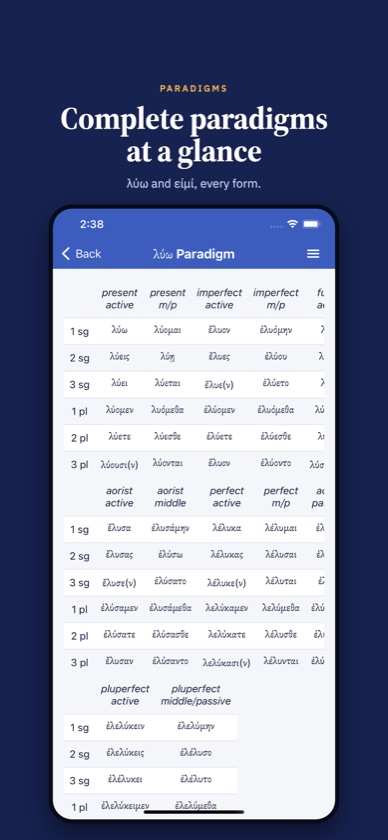
Every paradigm you need for reading the New Testament is here: the three declensions, the article, adjectives and pronouns, the full λύω paradigm, contract, liquid, second aorist and μι verbs, and the non-indicative forms. You can check a genitive plural or a first aorist passive ending without flipping back through your textbook.
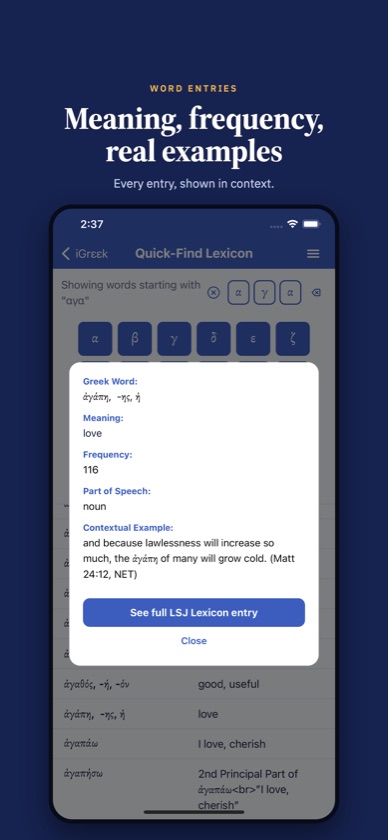
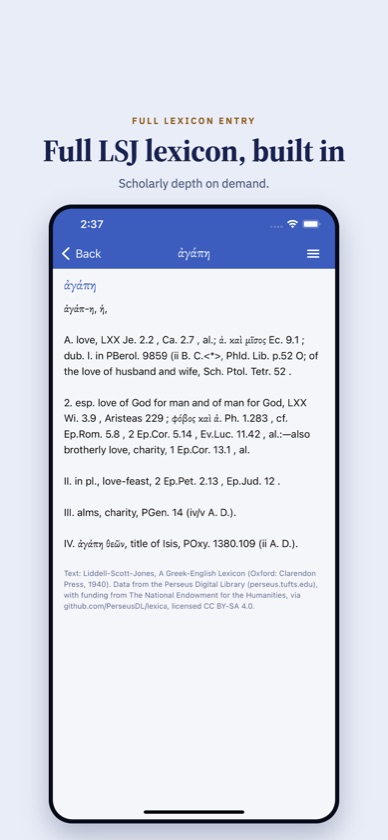
It is also a quick lexicon. Tap the first few letters of a word on the built-in Greek keyboard and the matches appear as you type. If you’re unsure of the lexical form, switch to inflected lookup and tap the word as it stands in the text, so ἔλυσεν leads you to λύω with its parsing. Each word shows its meaning, frequency, principal parts and an example verse, and most link to the full LSJ entry.
When you’re ready for more than forms, iGreek covers the functions of case, tense, voice and mood, flowcharts for participles and infinitives, conditional sentences and discourse features. Principal parts lists, short grammar videos and the Singing Grammarian songs round it out. Everything except the videos works offline.
What you can do
- Look up any New Testament word by tapping its first letters on a built-in Greek keyboard, with no accents or breathings to type.
- Find the lexical form of an inflected word by tapping it as it appears in the text, with a short parsing beside each match.
- Open a word card with meaning, frequency, part of speech, roots, English derivatives, a contextual example and principal parts.
- Read the full Liddell-Scott-Jones entry for about 4,500 words.
- Review noun, article, adjective, pronoun and numeral paradigms, including all three declensions.
- Study indicative verb formation and full paradigms for λύω, εἰμί, contract, deponent (lexical middle), compound, liquid, second aorist and μι verbs.
- Review participle, infinitive, subjunctive, imperative and optative formation with the λύω paradigm.
- Check the functions of case, tense, voice, mood, the article and adjectives, with flowcharts for participles and infinitives.
- Browse the full New Testament glossary, the common principal parts and an 880-verb principal parts list.
- Watch 5 grammar review videos and 18 Singing Grammarian songs inside the app.