iHebrew is for students with a year or two of Hebrew behind them who want to keep reading. When a form stops you, it gives you the paradigm, the stem or the gloss in seconds, so you can get back to the text.
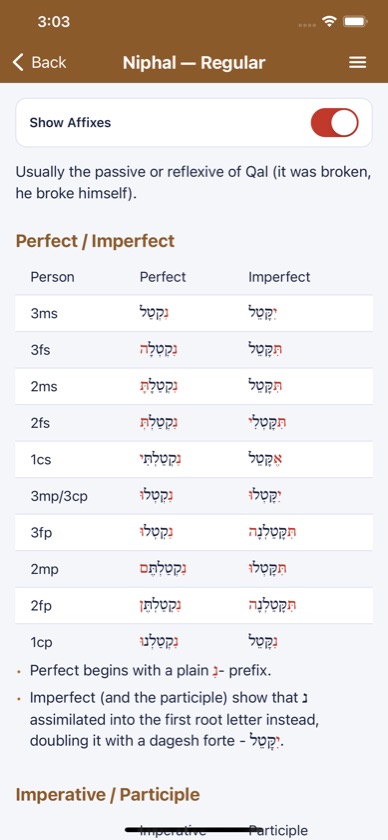
Every stem is here, Qal through Hithpael, with the weak roots that make Hebrew verbs hard: I-Guttural, I-Nun, I-Yod, III-He, III-Aleph, hollow and geminate. Browse the charts by stem or by root type, and turn on Show Affixes to see the prefixes and suffixes in red against the root.
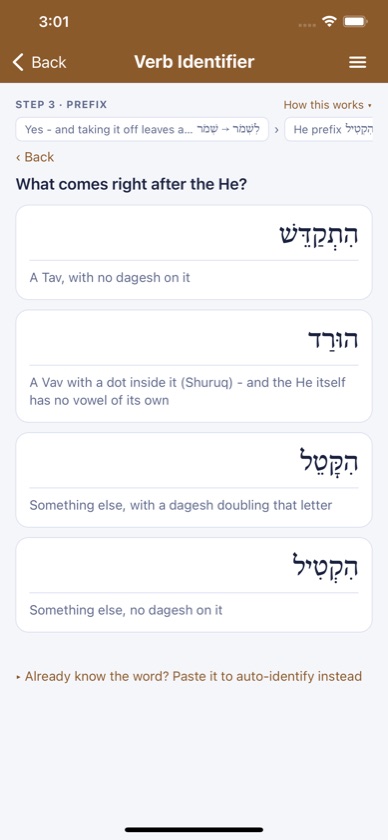
When you meet a verb you can’t place, the Verb Identifier walks you through it the way a teacher would at the whiteboard. It asks about the prefix, then doubling, then the vowels, and lands on the stem and conjugation, with a note on how sure it is and a link to the matching paradigm chart.
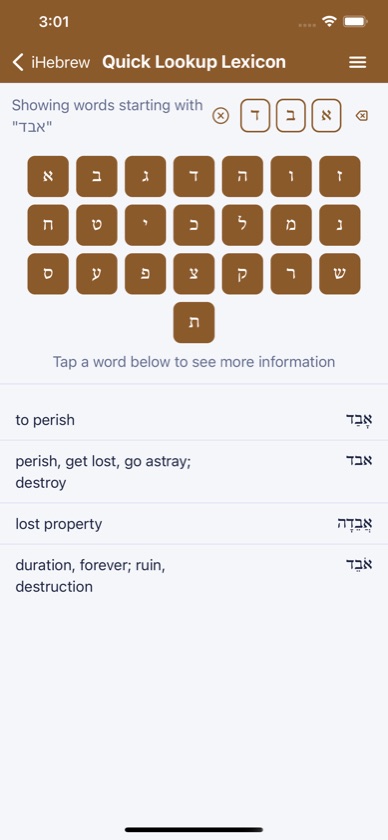
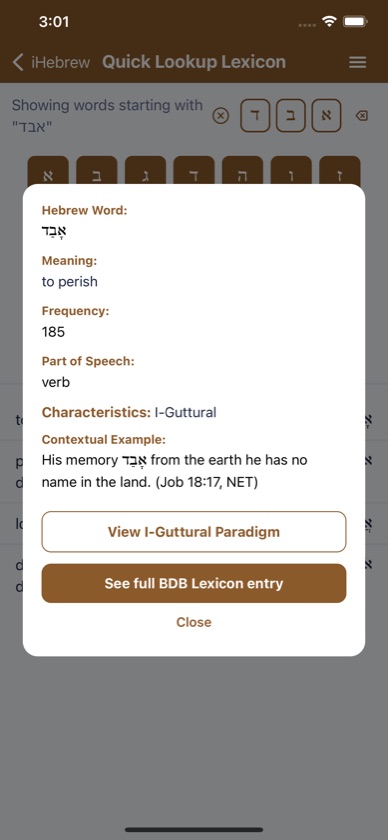
iHebrew is also a quick lexicon. Tap the consonants on the built-in Hebrew keyboard to find a word by its lexical form, or tap the word as it stands in the text to find its lemma and parsing. Each entry gives the meaning, frequency, weak-root features and an example verse, and most link to the full BDB entry. Grammar pages on nouns, pronouns, the construct chain, clauses and narrative syntax round it out, and everything except the songs works offline.
What you can do
- Look up any word in the Hebrew Bible by tapping its consonants on a built-in keyboard, with no vowel points or final forms to worry about.
- Find the lemma of an inflected form by tapping it as it appears in the text, with a parsing (stem, conjugation, person, gender, number) beside each match.
- Open a word card with meaning, frequency, part of speech, weak-root characteristics and an example verse, plus buttons to the matching paradigm charts.
- Read the full Brown-Driver-Briggs entry for over 7,500 words.
- Work out a verb's stem and conjugation step by step with the Verb Identifier, including rare stems like Polel, Pilpel and Hishtaphel.
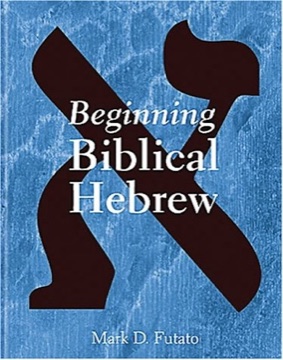
- Review 28 paradigm charts from Futato's Beginning Biblical Hebrew: all seven stems plus the weak roots, browsable by stem or by weak root.
- Highlight affixes in red across the paradigm and morphology pages with one switch.
- Study morphology (alphabet and vowels, nouns and adjectives, segolates, pronouns and suffixes, numerals, prepositions, the article) and syntax (construct chain, clauses, commands, participles, infinitives, narrative, poetry).
- Browse the full glossary by first letter.
- Choose light, dark or system appearance, and watch 6 songs for learning Biblical Hebrew.